 |

The Contents, Algorithms and Processing of the Cholesterol 2.0 and the Cholesterol Management Tool
follow exactly the Recommendations presented in the Executive Summary
of the Third Report of the National Cholesterol Education Program (NCEP). Expert Panel on
Detection, Evaluation and Treatment of High Blood Cholesterol in Adults (Adult Treatment Panel III)
See NCEP Guidelines.
|
Patient Profile Processing
|
| |
The Patient Profile section includes 7 subsections (Patient data, Parameters calculated,
Past Medical History, Social History, Family History, Laboratory tests, Parameters calculated (labs)).
Data in these sections is taken directly from the Input page, with the exception of the Parameters calculated,
which are dinamycally computed every time the create Profile button is pressed.
Calculated parameters are computed following standard formulas and equations that can be seen in the Medical
calculators section. For convenience, a calculated LDL value is computed by the program. The NCEP
ATP III Guidelines establish that the LDL value used for the assessments should be a measured one.
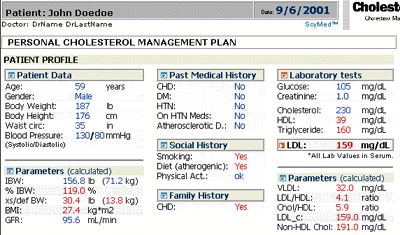
 Exhibit 10. Cholesterol 2.0™ Patient Profile, Output Page, Cholesterol Tool.
|
Risk Assessment Processing
|
| |
The Risk Assessment section includes 3 subsections: Major Risk Factors, Framingham Point Scores and Metabolic Syndrome.
All algorithms follow the NCEP ATP III Guidelines. When there is no input results default to "NA".
Major Risk Factors. Total number is calculated, an HDL value equal or greater than 60 accounts
for a "negative" risk factor (-1). Htn or on Htn meds is evaluated from inputs 11 and 12. The actual value of BP (input 6)
is not taken into account.
Framingham Point Scores are computed based on the Framingham Risk Scoring Tables
provided at the end of the NCEP ATP III Guidelines. Systolic Blood Pressure is taken from input 6
disregarding inputs 11/12. Total Points are always calculated even if only one of the
inputs is entered. The CHD 10-Year Risk is not computed when the patient has established CHD or a CHD-Risk equivalent.
Metabolic Syndrome. The total number of risk factors is computed always, 3 or more risk factors establish the
clinical diagnosis.
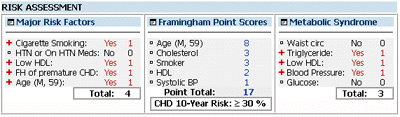
Exhibit 11. Cholesterol 2.0™ Risk Assessment, Output Page, Cholesterol Tool.
|
Risk Categorization Processing
|
| |
Risk Categorization follows the NCEP guidelines. See exhibit 12 below. First, the algorithm evaluates the presence or absence of CHD
and/or CHD Risk equivalent. If any is positive, the patient is in the CHD or CHD Risk equivalent category (1 Category), if not,
the algorithm checks the CHD 10-Year Risk through Framingham Point Scoring.
If >20%, it proceeds to check Major Risk factors (the Category is CHD and/or CHD Risk equivalent).
If the CHD 10-Year Risk is equal or lower than 20%, the system checks for the number of Major Risk factors.
If 2+ Risk factors are found, the patient goes to the 2+ Risk Factors category
and depending on the CHD 10-year risk, to 10-20% (2a Category) or less than 10% (2b Category).
The same process follows if the patient is found to have only 0-1 Major Risk Factors (goes to the 0-1 Risk
Factors) (3 Category) the algorithm then checks the CHD 10-year risk. Most patients with 0-1 Risk factors will have a
CHD 10-Year Risk lower than 10%, however there are some with higher CHD 10-Year Risk.
The NCEP ATP III Guidelines (Executive Summary) doesn't discuss the possiblilities of having 0-1 Risk Factors
and a CHD 10-Year Risk of more than 20% or more than 10%. These clinical situations are rare, but certainly possible,
this application categorizes these patients according the number of Risk factors and warns about the higher CHD 10-Year
Risks. See table 5 of the NCEP ATP III
Executive Summary Guidelines

Exhibit 12. Cholesterol 2.0™ Risk Categorization Algorithm.
Exhibit 13 below shows an example of CHD or CHD Risk Equivalent category (1 Category).
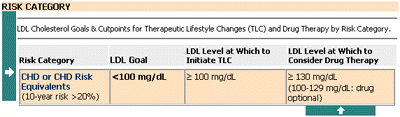
Exhibit 13. Cholesterol 2.0™ Risk Categorization, Output Page, Cholesterol Tool.
|
Therapeutic Recommendations Processing
|
| |
Therapeutic Recommendations follow the NCEP ATP III guidelines. Depending on the Risk Category
and the LDL level, Patients are classified. First, LDL-lowering Therapy Recommendations, then Clinical
Metabolic Syndrome (if present), Triglycerides and HDL. Hyperlinks to the specific sections of the NCEP ATP III
Guidelines are included.
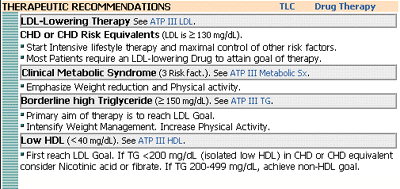
Exhibit 14. Cholesterol 2.0™ Therapeutic Recommendations, Output Page, Cholesterol Tool.
|
|
 |
The Processing algorithms follow exactly the NCEP ATP III Guidelines.
|
|


















 back
back